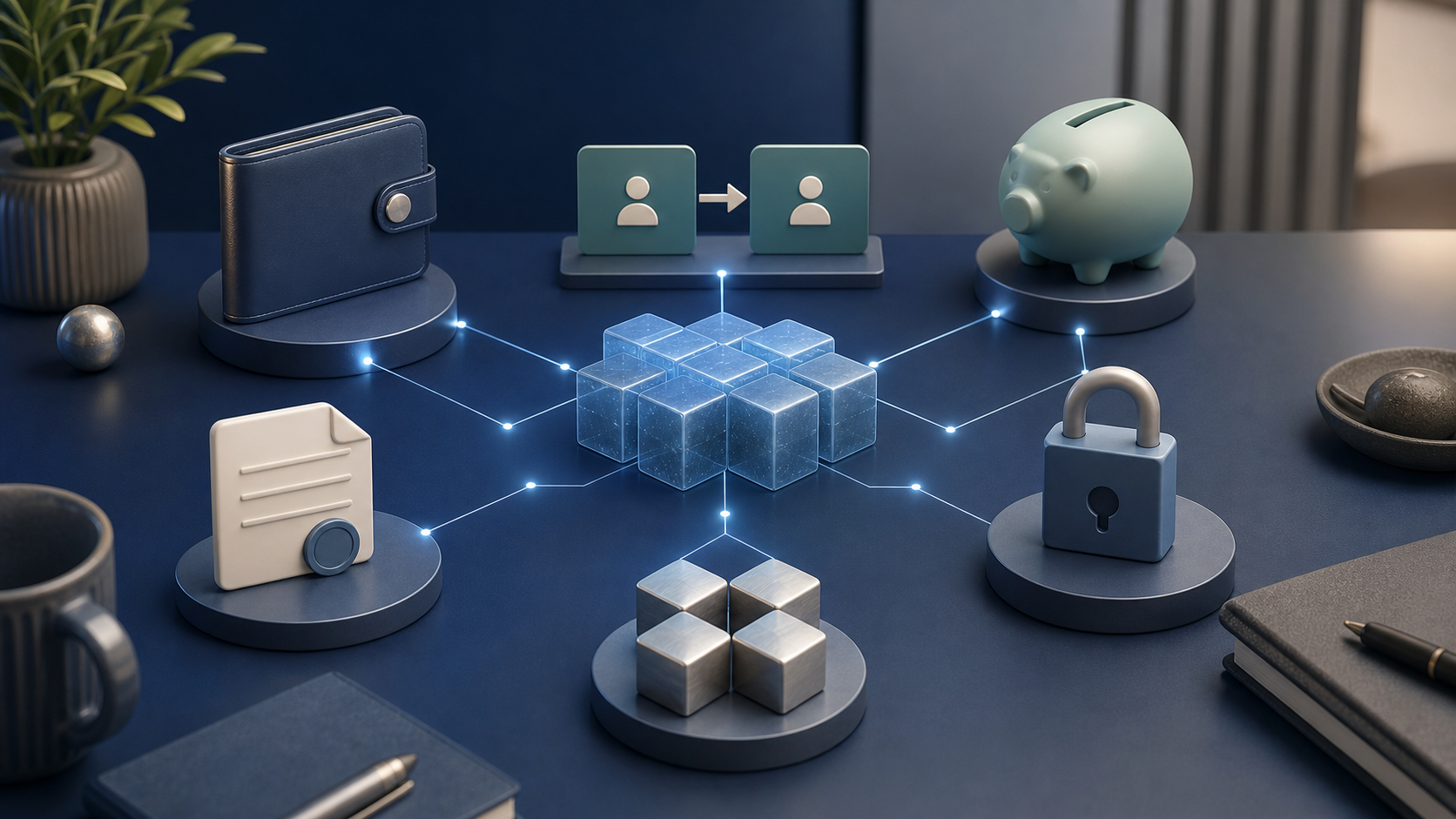
Crypto is often presented as a market screen filled with fast-moving prices. That view misses a quieter shift. Blockchain networks are increasingly used as financial infrastructure: moving digital dollars, coordinating lending, recording ownership, and automating settlement. A person can interact with this infrastructure without trying to predict whether a token will rise tomorrow. The relevant question is not “What should I trade?” but “Which financial task is the technology performing, and what new risks come with it?”
Digital money movement
Stablecoins are one of the clearest non-trading uses. These tokens are designed to track a reference currency, often the US dollar, and move between compatible wallets on a blockchain. Current crypto reference data classifies USDT and USDC as dollar stablecoins. Common applications include remittances, supplier payments, treasury transfers, and moving value between services.
The transaction layer operates beyond bank opening hours, but the overall experience still depends on conventional finance. A user needs a way to exchange bank money for a stablecoin, and the recipient often needs to convert it into local currency. Issuer reserves, redemption rights, wallet security, network fees, and local rules all affect whether the process is dependable. A digital token that aims to hold a stable value is not identical to an insured bank deposit.
Saving, earning, and borrowing
Blockchain-based finance also separates familiar activities into programmable services. A current Criffy catalog groups live offerings into earn, borrow, and collateral categories across exchanges, wallets, and protocols. Earn offerings include savings, staking, lending, or decentralized-finance strategies. Borrowing records display borrowing and supply rates, available liquidity, and active status, while collateral records include loan-to-value and liquidation thresholds.
These labels do not make the services interchangeable. Staking rewards come from network participation, lending returns depend on borrower demand and platform design, and a promotional savings rate often has account limits or changing terms. In decentralized lending, smart contracts execute rules automatically, but users also face contract, oracle, liquidation, and governance risks. APY and availability change, so the source platform and current terms should be checked before any action.
Collateral-backed borrowing illustrates how crypto is used without being sold. A holder locks an asset and borrows another asset against it. The trade-off is important: if collateral value falls far enough, the position faces liquidation. Borrowing costs, thresholds, fees, and repayment conditions need to be understood together. This is a credit decision, not a way to avoid financial risk.
Wallets become financial access tools
A wallet is more than a place to display a balance. It manages the credentials used to authorize transactions and connects to payment, lending, identity, or tokenized-asset services. A self-custody wallet gives the user direct control of keys, while a custodial service manages access on the user’s behalf. The first model increases personal responsibility; the second introduces reliance on the provider.
Everyday usability depends on recovery and safety. Users should understand how backups work, whether a transfer is reversible, which network an asset uses, and how suspicious approvals are revoked. Sending an authentic token over the wrong network or approving a malicious contract may cause losses even when the underlying blockchain works exactly as designed.
Tokenization and automated settlement
Blockchain systems represent more than currencies. Financial institutions are exploring tokenized deposits, securities, funds, and other claims whose ownership is updated on shared ledgers. Smart contracts coordinate delivery and payment, distribute cash flows, or apply eligibility rules. The goal is often operational: reduce reconciliation, keep records in sync, and shorten the gap between a trade and its settlement.
This does not mean every asset should move to a public blockchain. Legal ownership, privacy, identity, data correction, and governance still require institutions and enforceable rules. Some systems will use permissioned ledgers; others will connect regulated services to public networks. The technology is likely to sit behind financial products rather than become the feature consumers consciously choose.
What remains familiar
Blockchain does not eliminate the need for budgets, clear fees, customer support, tax records, or consumer protection. It changes how instructions and assets are recorded and executed. Banks, payment companies, crypto firms, and software providers often appear in the same service, each responsible for a different layer.
For consumers, the best starting point is a practical checklist: What task does the service perform? Who holds the assets? What backs any stable-value token? Which fees apply at entry, transfer, and exit? What happens after a mistake or provider failure? Which rules protect the user in their jurisdiction?
Key takeaways
- Blockchain finance extends beyond trading into payments, saving, lending, collateral, custody, and settlement.
- Stablecoins can move digital value efficiently, but they still rely on issuers, networks, access providers, and local currency gateways.
- Automated products introduce specific smart-contract, custody, liquidity, and liquidation risks.
- Useful adoption will be measured by reliability and consumer outcomes, not by how visible the blockchain is.
This article is educational and not financial advice. Product availability and terms can vary by region, account, and provider.